
Categories
BuyingPublished May 2, 2026
Townhouse vs Single Family Home

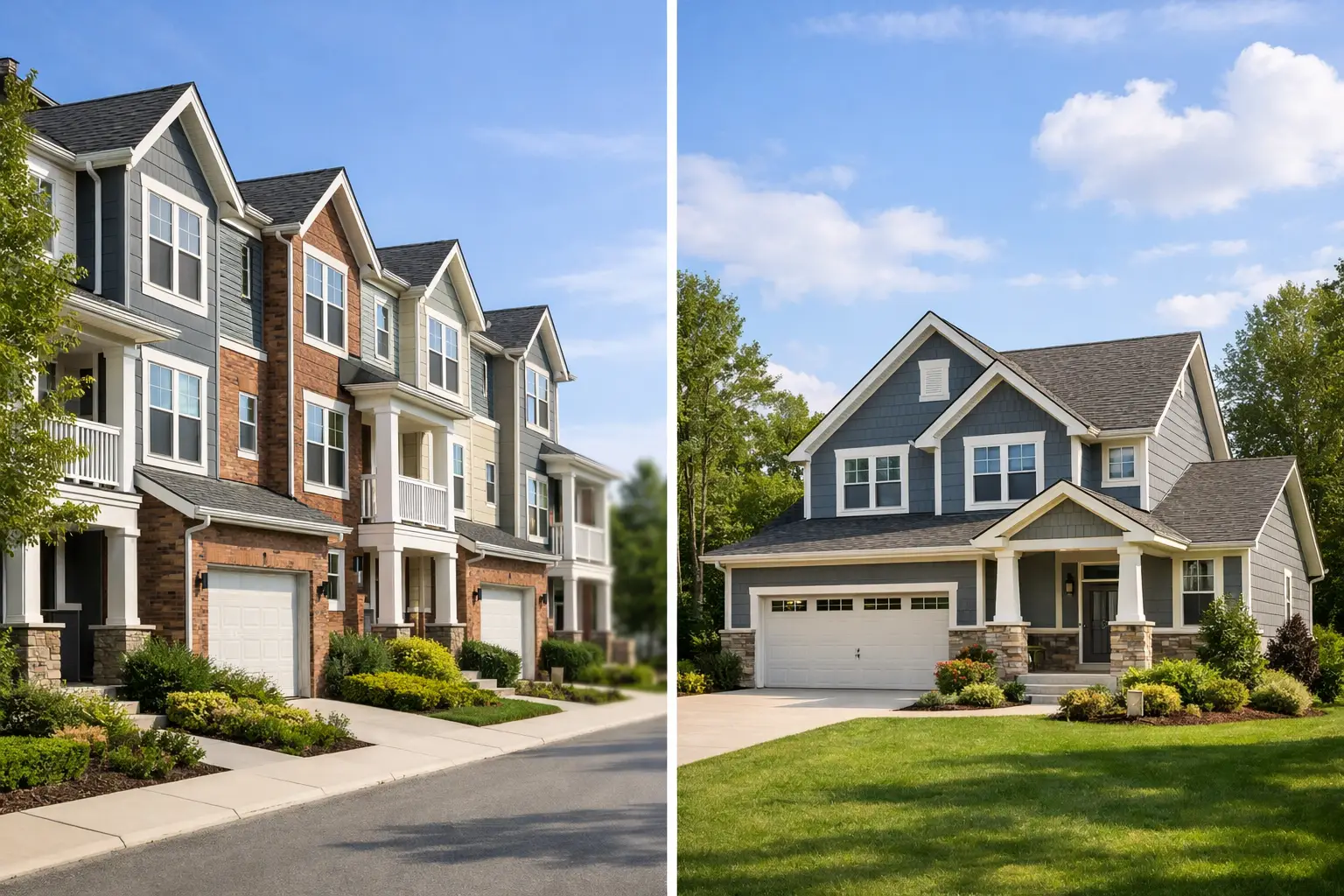
If you're torn between a townhouse vs single family home, you're probably not just comparing floor plans - you're deciding how you want to live day to day. The right choice affects your budget, your maintenance responsibilities, your privacy, and even how flexible your next few years will feel.
For buyers across Hampton Roads and the Virginia Peninsula, this decision comes up often. A townhouse may offer a lower entry price and less exterior upkeep. A single-family home may give you more space, more privacy, and more control. Neither is automatically better. The better fit depends on your finances, your routine, and what you want homeownership to feel like.
Townhouse vs single family home: the biggest difference
At the simplest level, a townhouse is an attached home that shares one or more walls with neighboring properties, while a single-family home stands on its own lot. That basic difference shapes almost everything else.
With a townhouse, you're usually buying the interior living space and a smaller outdoor footprint. In many communities, an HOA handles some exterior maintenance, common areas, and neighborhood standards. With a single-family home, you typically have more land, more separation from neighbors, and more responsibility for the property's upkeep.
That means this is not only a price comparison. It's a lifestyle comparison.
Cost is more than the purchase price
A townhouse often looks more affordable upfront, and sometimes it is. In many local markets, townhomes can provide a more accessible path into homeownership, especially for first-time buyers, military families relocating on a timeline, or buyers who want to keep monthly costs manageable.
But the lower list price does not always mean lower total cost. HOA dues can add a meaningful amount to your monthly payment. In return, those dues may cover exterior maintenance, roof replacement schedules, landscaping, neighborhood amenities, or insurance for shared structures. The value of that depends on how much you want those responsibilities off your plate.
A single-family home may cost more upfront and may come with higher utility costs, more maintenance, and bigger repair expenses over time. If the fence needs replacing, the siding needs work, or the yard needs attention, that is usually yours to handle. On the other hand, you are not generally paying monthly HOA fees at the same level as many townhouse communities, and you may have more freedom in how you spend money on improvements.
When buyers compare a townhouse vs single family home, we encourage them to look at the full monthly picture: mortgage, taxes, insurance, HOA dues, utilities, and maintenance reserves. That number tells the truth faster than the sale price alone.
Privacy and space matter more than people expect
A lot of buyers think they can compromise on privacy or outdoor space, then realize later that those details shape everyday comfort.
Townhouses can live larger than buyers expect, especially newer ones with multiple stories and smart layouts. You may get three bedrooms, a garage, and updated finishes at a price point that would be harder to reach in a detached home. For some households, that trade works very well.
Still, shared walls are shared walls. Noise, parking, guest traffic, and proximity to neighbors all come with attached living. Some buyers do not mind that at all. Others know quickly that they want more separation.
Single family homes usually offer more yard space, more distance from neighbors, and more flexibility for things like pets, play areas, gardening, or outdoor entertaining. If having your own driveway, fenced yard, or room to spread out is high on your list, a detached home may feel worth the added cost and maintenance.
Maintenance is where lifestyle really shows up
This is one of the clearest dividing lines.
A townhouse can be appealing because it reduces some of the hands-on work that comes with ownership. If you travel often, work long hours, or simply do not want every weekend tied up with yardwork and exterior projects, townhouse living can feel more manageable. That is especially true for buyers who want a home, not a long to-do list.
A single-family home gives you more control, but it also gives you more responsibility. You are the one arranging repairs, budgeting for major systems, caring for the lawn, and handling exterior maintenance. Some people love that. They want full control over their property and do not want to answer to an HOA. Others would rather trade some independence for convenience.
Neither preference is wrong. It is just important to be honest about your time, energy, and tolerance for surprise repairs.
Rules, restrictions, and flexibility
One of the most overlooked parts of the townhouse decision is the HOA. Some associations are well run and protect property values effectively. Others can feel restrictive, especially if you want freedom to make changes.
Before buying a townhouse, it helps to understand what the HOA covers and what it limits. There may be rules about parking, exterior paint, fencing, rentals, pet policies, trash storage, or even holiday decorations. Those rules are not always deal-breakers, but they should never be a surprise.
Single family homes can also be subject to HOA rules in certain neighborhoods, but detached properties often offer more flexibility overall. If you care strongly about renovating, building out a backyard, storing recreational equipment, or making the property your own over time, a single-family home may line up better with your goals.
Resale depends on the buyer pool
Both property types can resell well. The question is who your likely future buyer will be.
Townhouses often appeal to first-time buyers, downsizers, busy professionals, and buyers who prioritize location and convenience. In areas where affordability is tight, townhomes can remain in steady demand because they offer an attainable ownership option.
Single family homes often attract a broader buyer pool, especially households that want more space, a yard, or long-term flexibility. That broader appeal can help at resale, but market conditions still matter. Price point, school zone, neighborhood condition, and inventory levels all play a role.
In Hampton Roads, local market dynamics can shift from one city or neighborhood to the next. A townhouse in a strong location with low maintenance appeal may outperform expectations. A detached home in a less competitive area may sit longer. That is why the property type should always be evaluated in the context of the specific neighborhood, not in a vacuum.
Which option fits different stages of life?
For many first-time buyers, a townhouse is the practical move. It can offer homeownership sooner, with less maintenance and a lower barrier to entry. If your goal is to start building equity without stretching every part of your budget, that can be a smart path.
For move-up buyers, growing households, or people planning to stay put for a long time, a single-family home often becomes more appealing. More space, more storage, and more outdoor use can matter a lot over time.
For military-connected buyers or relocation households, the answer often depends on assignment length and lifestyle. If you want easier upkeep and a lock-and-leave setup, a townhouse may make more sense. If you expect to settle in the area longer and want room to grow, a detached home may be worth pursuing.
For downsizers, it can go either way. Some want a townhouse because they are done with exterior chores. Others still want privacy and one-level living, which can point them toward a smaller single-family home instead.
How to make the decision with confidence
If you're stuck on townhouse vs single family home, try shifting the question. Instead of asking which property type is better, ask which one best supports the life you expect to live over the next five to seven years.
Think about your monthly comfort zone, not just your loan approval. Think about whether you want to spend Saturdays maintaining a yard or doing something else. Think about noise, pets, guests, parking, storage, and how much flexibility you want if your needs change.
It also helps to compare real examples side by side in the same price range. A townhouse and a single-family home at similar monthly payments can offer very different trade-offs. Seeing those options in person usually brings clarity fast.
At Horak Realty Group, we often walk buyers through this exact decision because the right answer is rarely one-size-fits-all. A good home choice should support your finances and your peace of mind.
The best home is not the one that sounds better on paper. It is the one that fits your daily life, your budget, and the version of homeownership you actually want to step into.

Ashley Horak
Owner | Realtor ® | Coach | Horak Realty Group | Mission Realty Group LLC
or another way